
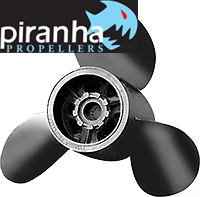
Piranha
Piranha propellers made from Verton® are 10-15% stronger than aluminum. Because the blades are removable, you do not need a complete new propeller after impact damage; replacing the damaged blade is enough. Hub slippage and the engine going into limp mode, common with other propellers, do not occur because Piranha hubs (HUB) have a lifetime warranty. Changing blades also lets you change propeller pitch.
Strength comparison:
- Verton®: 42,000 psi
- Die-cast aluminum: 36,000 psi
- Other composites: 26,000 psi
Propeller Selection
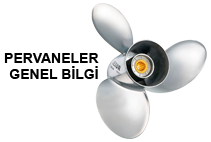
Pitch is the theoretical distance a propeller travels forward in one revolution. Propellers are described by diameter then pitch (example: in a 13 17 combination, 13 inch (1 inch=2.54 cm) is the tip-to-tip diameter and 17 inch is the pitch). Pitch can also be thought of as speed.
In our country, outboard engines are often sold already fitted without knowing the boat. Correct performance is therefore left to chance. The aim of propeller selection is the highest speed at the lowest engine rpm, reaching the most efficient WOT (Wide Open Throttle) range. This is usually 4500 to 5500 RPM depending on the engine, and is listed in the owner’s manual.
Pitch and engine rpm (revolutions per minute) move in opposite directions. Increasing pitch lowers rpm; decreasing pitch raises rpm. A 1 inch pitch change is normally about 200 RPM. If the engine runs below the manufacturer’s recommendation, consider a lower-pitch propeller.
Videos
Durability Test
Propeller Introduction
Compatible brands